


 +86 18130251359
 teflowpumps@tlpumps.com

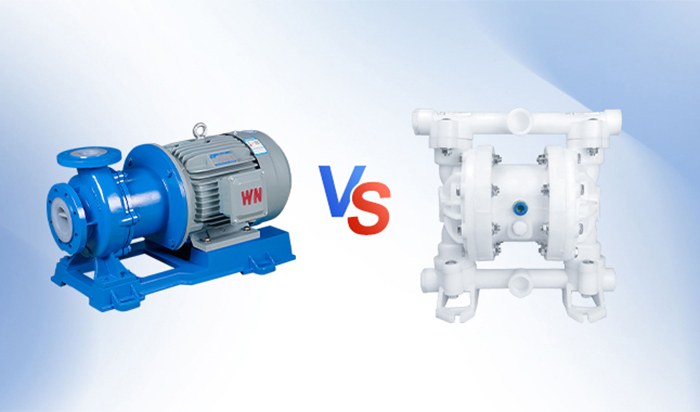
In the field of chemical fluid transportation, magnetic drive pumps and diaphragm pumps are two widely adopted core pump types. Both feature zero leakage and good compatibility with corrosive media. However, they differ fundamentally in working principle, structural design and operating characteristics. Many chemical enterprises often misjudge their applicable scopes during equipment selection, leading to problems such as over-specification and mismatched working conditions. These issues further cause excessive energy consumption, premature equipment failure and production shutdown risks. This article comprehensively compares the two pump types from four dimensions: working principle, core performance, applicable scenarios and operation & maintenance costs, providing professional references for accurate pump selection under chemical working conditions.
1. Working Principles: Distinct Fluid Conveying Mechanisms
The essential difference between magnetic drive pumps and diaphragm pumps lies in their fluid delivery principles. The former adopts centrifugal continuous conveying, while the latter is positive displacement reciprocating conveying, which fundamentally determines their operating features and application adaptability.
1.1 Magnetic Drive Pump: Magnetic Coupling & Centrifugal Continuous Conveying
It operates based on magnetic transmission and centrifugal force. The motor drives the outer magnetic rotor to rotate at high speed. Magnetic lines penetrate the isolation sleeve to drive the inner magnetic rotor inside the pump chamber to run synchronously in a non-contact manner, and further rotate the impeller at high speed. The rotating impeller generates centrifugal force, creating negative pressure for medium suction and high pressure for discharge, forming continuous fluid flow. Since no mechanical drive shaft penetrates the pump body and the isolation sleeve fully seals the medium chamber, complete zero-leakage conveying is realized.
This type of pump delivers stable, pulsation-free and high-speed continuous flow. As a constant-speed centrifugal conveying device, it is the mainstream choice for transporting clean chemical fluids.
1.2 Diaphragm Pump: Diaphragm Reciprocation & Positive Displacement Intermittent Conveying
Fluid suction and discharge are completed by volume variation. The driving mechanism pushes the diaphragm to perform reciprocating telescopic movement. When the diaphragm stretches, the pump chamber expands to form negative pressure, the inlet check valve opens and the outlet valve closes, drawing medium into the chamber. When the diaphragm compresses, the chamber shrinks and pressure rises, the inlet valve closes and the outlet valve opens, and the pressurized medium is discharged. Continuous fluid delivery is achieved through high-frequency reciprocating motion of the diaphragm.
Due to the alternating opening and closing of check valves and intermittent deformation of the diaphragm, the delivered fluid has slight pulsation and uneven flow velocity. It is categorized as an intermittent positive displacement conveying device.
2. In-depth Comparison of Core Performance: Clear Differences in Applicable Working Conditions
2.1 Sealing Performance & Safety
Magnetic drive pumps adopt an all-static sealing structure with no dynamic sealing components. The isolation sleeve completely separates the medium from the external environment, eliminating leakage from the source. Featuring extremely reliable sealing performance, they are suitable for highly toxic, flammable and explosive, high-purity and strongly corrosive media, complying with safety regulations for high-risk chemical working conditions with no leakage risks during long-term operation.
Diaphragm pumps isolate media via diaphragms and check valves and can also achieve zero leakage in general. Nevertheless, the diaphragm is a flexible wearing part prone to fatigue aging and micro-damage after long-term reciprocating deformation. Check valves may also suffer from sticking and poor sealing. Therefore, diaphragm pumps carry slightly higher leakage risks in long-term operation. They are ideal for conventional corrosive media but less applicable to highly toxic and hazardous fluids.
2.2 Flow Rate, Pressure & Operational Stability
With high rotating speed and continuous fluid flow, magnetic drive pumps deliver stable pulsation-free flow and uniform pressure. The flow rate can be precisely adjusted via frequency conversion for steady output without fluid impact, making them suitable for processes requiring high flow stability and medium purity. However, their pressure bearing capacity is limited. They are mainly used for medium and low pressure scenarios, and may experience weakened magnetic transmission and reduced efficiency under high pressure.
Diaphragm pumps excel at low-pressure large-flow and high-pressure operation. Their output pressure is independent of rotating speed, enabling high-pressure small-flow delivery for high-pressure liquid replenishment and slurry transportation. On the downside, obvious fluid pulsation and low flow regulation accuracy (relying on stroke adjustment) make them unable to meet requirements for high-precision and high-stability fluid conveying. The maximum working pressure of standard diaphragm pumps is generally below 10 bar, so they are not fit for ultra-high pressure conditions.
2.3 Medium Compatibility
Magnetic drive pumps are designed for clean, low-viscosity and particle-free fluids, including clean water, acid-base solutions, organic solvents and high-purity reagents. Given the narrow clearance between the impeller and pump body, they are strictly prohibited from handling media containing solid particles, crystals or high-viscosity substances, which may cause impeller sticking, abrasion and magnetic transmission failure. Dry running will also lead to overheating and damage of the isolation sleeve.
Diaphragm pumps boast outstanding medium adaptability, capable of handling high-viscosity fluids, particle-laden media, slurries and crystallizable substances such as coatings, mud, resins and suspensions. The flexible diaphragm cushions impact from solid impurities, and the large-flow passage of check valves effectively prevents clogging. They are also applicable to gas-liquid mixed media, serving as the preferred option for complex chemical fluid transportation.
2.4 Energy Consumption & Noise
The motor of a magnetic drive pump directly drives the magnetic transmission system, resulting in low power loss, high transmission efficiency and low energy consumption during continuous operation. The unit runs smoothly with slight vibration and low noise, well suited for long-duration continuous operation.
The reciprocating motion of diaphragm pumps generates mechanical impact and larger power loss, consuming more energy than magnetic drive pumps at the same flow rate. Obvious pulsating vibration and louder noise occur during operation, leading to higher cumulative energy costs under long-term high-frequency service.
3. Segmented Applicable Scenarios: Guidelines for Accurate Chemical Pump Selection
3.1 Optimal Application Scenarios for Magnetic Drive Pumps
Magnetic drive pumps are prioritized for working conditions requiring cleanliness, safety, continuous stability and high precision:
- Transportation of high-risk clean media: Delivery of high-purity reagents and sterile liquids in fine chemical and pharmaceutical industries, as well as flammable, explosive and highly toxic organic solvents in petrochemical sector. Its zero-leakage property ensures production safety and medium purity.
- Continuous production lines:24-hour uninterrupted systems such as chemical rectification, extraction and circulating cooling systems. Stable pulsation-free fluid flow guarantees smooth production without shutdown failures.
- Environmentally compliant operations: Conveyance of acid and alkali chemicals for wastewater treatment and circulating washing liquid for waste gas treatment, eliminating pollution and safety hazards caused by chemical leakage and meeting environmental discharge standards.
- High-precision flow control: Chemical proportioning, micro liquid replenishment and fluid delivery in automated production lines. High-precision frequency conversion adjustment ensures accurate process batching.
3.2 Optimal Application Scenarios for Diaphragm Pumps
Diaphragm pumps are ideal for complex media, intermittent operation and anti-clogging working conditions with high pressure:
- Transportation of high-viscosity and particle-containing slurries: Delivery of coatings, inks, resins and adhesives, as well as transfer of chemical sludge and waste residue slurries, solving clogging and abrasion problems of traditional pumps.
- Intermittent operation: Loading and unloading of chemical raw materials, tank liquid replenishment and intermittent batching processes. The pump can run dry without burnout risks and features flexible start-stop performance for discontinuous operation modes.
- High-pressure small-flow liquid replenishment: Micro liquid feeding for high-pressure chemical reactors and pipeline pressurization. Its positive displacement high-pressure output meets the demands of high-pressure processes.
- Transportation of gas-liquid mixed and crystallizable media: Handling of bubble-containing chemical wastewater and crystallizable salt solutions. It resists clogging and crystal adhesion, adapting to harsh medium conditions.
4. Comparison of Operation & Maintenance Costs and Service Life
Lifecycle cost is a key factor for chemical pump selection. The two pump types differ greatly in wearing parts, maintenance frequency and repair difficulty.
Magnetic drive pumps have very few wearing parts, with no conventional consumables like mechanical seals and packings. Core components including isolation sleeves, magnetic rotors and impellers enjoy long service life. Under normal operating conditions, routine maintenance is required only a few times a year, mainly involving regular inspection of bearings and lubrication status. Repairs are simple with low consumable costs, delivering excellent cost performance throughout the long-term continuous service life. The main limitation is that dry running and particle-containing media are strictly forbidden, as improper operation will rapidly damage core components.
Diaphragm pumps have concentrated wearing parts with fast attrition. Diaphragms, check valve balls and gaskets need frequent replacement due to aging and damage from long-term reciprocating deformation. Maintenance is required every 1 to 3 months under high-frequency operation, resulting in high costs for consumables and manual labor. On the other hand, they feature strong fault tolerance: dry running and no-load operation are allowed, and they resist impact from impurities. Troubleshooting and repair are convenient without complicated disassembly.
5. Selection Summary: Core Decision-Making Principles
Based on the above comparison, follow the core principles below for pump selection in the chemical industry:
Choose a magnetic drive pump preferentially if the working conditions involve clean particle-free media,24-hour continuous operation, strict requirements on leakage control, flow stability and medium purity, as well as demands for low maintenance cost, low energy consumption and high safety.
Choose a diaphragm pump preferentially for working conditions with complex media (high viscosity, particles, crystals, gas-liquid mixture), intermittent operation and high-pressure small-flow delivery, where equipment fault tolerance takes precedence over continuous stability.
Against the general trend of intelligent and eco-friendly chemical production, accurate selection of fluid transportation equipment can not only ensure process stability, but also effectively reduce energy consumption, maintenance and safety costs. Magnetic drive pumps and diaphragm pumps are not substitutes for each other, but complementary to diverse chemical working conditions. Enterprises can maximize equipment efficiency by selecting the right pump according to medium characteristics, operation modes and process parameters.



 +86+0563-5093318
