


 +86 18130251359
 teflowpumps@tlpumps.com

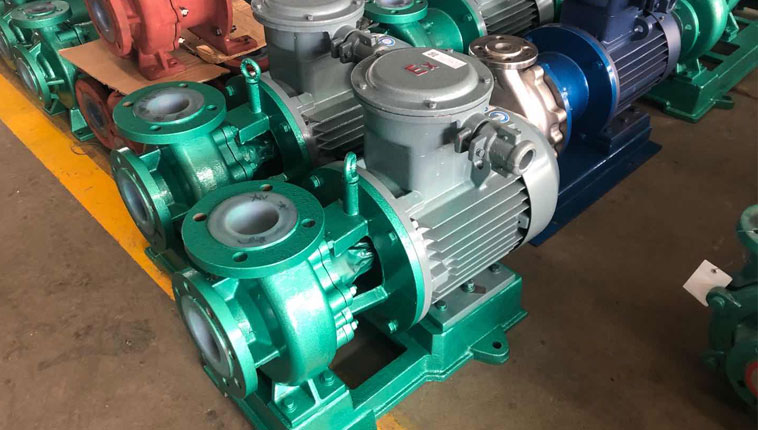
Every chemical pump must undergo a series of stringent and standardized performance tests before leaving the factory. These tests serve not only as the final gatekeeper for product quality, but also as a formal commitment to users regarding operational safety.
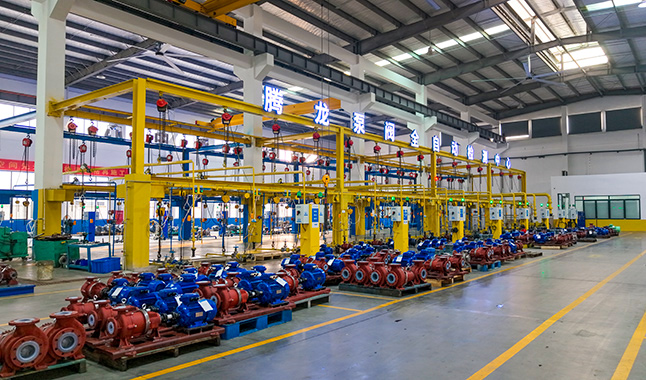
I. General Performance Tests: Verification of Basic Performance and Integrity
Whether magnetic pumps or centrifugal pumps, the following tests are mandatory prerequisites for factory shipment, designed to verify their basic hydraulic performance, mechanical integrity and sealing reliability.
1. Hydraulic Performance Test (Core Test)
Purpose: To confirm that the actual operating parameters of the pump meet the design specifications, which is the direct basis for evaluating pump efficiency and working capacity.
Content:
①Flow-head curve: Measure the head (pressure) corresponding to different flow points at a constant speed and plot the curve. It is required to verify that the rated operating point falls within the designed range.
②Flow-efficiency curve: Measure the pump efficiency at each flow point to determine the maximum efficiency zone, ensuring the pump operates in the high-efficiency zone for energy conservation.
③Flow-shaft power curve: Measure the power required to drive the pump, providing a basis for motor selection and checking for overload risks.
④Net Positive Suction Head (NPSH) test: Determine the required NPSH of the pump, a critical parameter to prevent cavitation and ensure stable operation.
2. Operation Test and Mechanical Inspection
Purpose: To evaluate the stability and reliability of the pump's mechanical state during operation.
Content:
①No-load/load operation: Continuously operate the pump under rated working conditions or specified conditions (usually for more than 1-2 hours) and inspect for abnormal vibration, overheating or noise.
②Vibration test: Use professional instruments to measure the vibration velocity or displacement at key parts of the bearing housing and pump casing, ensuring compliance with the grades specified in ISO, API and other standards.
③Bearing temperature monitoring: Monitor the bearing temperature rise during operation to ensure it stays within a safe range, preventing premature damage caused by improper assembly or poor lubrication.
3. Hydrostatic Test (Casing Strength Test)
Purpose: To verify the strength and sealing performance of pressure-bearing components (pump casing, shaft seal chamber, etc.) and ensure no leakage or deformation occurs.
Content: Conduct a pressure-holding test on the pump body with ambient temperature clean water at 1.5 times the maximum allowable working pressure (or the pressure specified in the design). The holding duration shall follow standard requirements (e.g., 10-30 minutes), and all static sealing points shall be inspected for leakage or permanent deformation.
4. Auxiliary System Inspection
Purpose: To confirm the normal functionality of pump-matched auxiliary systems.
Content: Inspect the correctness and unobstructedness of pipeline connections for cooling, flushing and lubrication; verify the reading accuracy of monitoring instruments (e.g., pressure gauges, temperature sensors).
II. Special and Safety Tests: In-depth Verification for Core Differences
Magnetic pumps adopt non-contact magnetic coupling transmission, while centrifugal pumps mostly use mechanical seals, leading to differences in their key safety characteristics. Therefore, targeted special tests are carried out for each type with distinct priorities.
Special Tests for Magnetic Pumps
1.Isolation sleeve (sealing sleeve) pressure-holding and leakage test: This is the core safety test for magnetic pumps. The isolation sleeve is the only static barrier preventing medium leakage. A strict pressure-holding and leak detection test is performed on its independent cavity with gas (e.g., nitrogen) or liquid at a pressure higher than the design pressure to ensure its integrity. Any micro-leakage may indicate potential safety hazards.
2.Magnetic torque transmission capacity test (decoupling test): Verify the slip torque margin of the internal and external magnetic steel assemblies under the maximum operating temperature and medium viscosity. Simulate abnormal working conditions (e.g., accidental overload, jamming) to check whether the magnetic coupling can slip as designed, thereby protecting the motor and pump—an embodiment of its overload protection function.
3.Eddy current heat and temperature rise test: Eddy current heating occurs in the isolation sleeve during the operation of magnetic pumps. The test verifies that the pump's temperature rise is within a controllable range when conveying the specified medium under working conditions, avoiding medium vaporization or magnet demagnetization caused by overheating.
4.Bearing system reliability verification: Bearings inside magnetic pumps are usually lubricated by the conveyed medium. The test simulates actual working conditions to verify the wear and operational stability of sliding bearings (e.g., silicon carbide) in the medium.
Special Tests for Centrifugal Pumps (Mechanical Seal)
1.Mechanical seal leakage test: This is the top priority for centrifugal pumps with mechanical seals. During and after the operation test, special methods (e.g., collection method) are used to accurately measure or confirm the seal leakage rate, ensuring it meets the stringent requirements of industry standards (e.g., API 682) or contracts, and achieves "zero visible leakage" or the specified limit value.
2.Seal flushing pipeline pressure and flow test: Verify that the pressure and flow of the auxiliary pipeline system providing cooling, lubrication or flushing for the mechanical seal meet the design requirements under simulated working conditions, a key factor to ensure the long-cycle operation of the seal.
3.Bearing housing sealing test: Prevent lubricating oil leakage and the intrusion of external contaminants.
For chemical magnetic pumps and centrifugal pumps, a comprehensive and rigorous factory performance test system is far more than a simple quality inspection process. It is the final verification of engineering design, a touchstone for manufacturing processes, and a preemptive defense line against safety risks. Only after passing multiple tests including hydraulic performance, mechanical operation, pressure integrity and special safety tests, can every pump delivered to the site be guaranteed to be not just a piece of equipment, but a pledge of reliable operation.



 +86+0563-5093318
