


 +86 18130251359
 teflowpumps@tlpumps.com

In industrial processes such as coal chemical engineering, petroleum refining, pesticide and pharmaceutical intermediates, printing and dyeing, and seawater utilization, the production of high-concentration saline wastewater is increasing day by day. Such wastewater usually contains high concentrations of chloride ions (Cl⁻), sulfate ions (SO₄²⁻), as well as sodium, calcium and other ions, with the total dissolved solids (TDS) mass fraction often exceeding 3.5%. In addition to inorganic salts, these wastewaters are frequently accompanied by organic pollutants, featuring strong corrosiveness and complex compositions, which impose stringent requirements on conveying equipment.
I. Core Requirements for Pumps Based on High-Concentration Saline Wastewater Characteristics
The prerequisite for pump selection is to clarify the core characteristics of high-concentration saline wastewater, which place targeted demands on the material, sealing, structure and performance of magnetic drive pumps and centrifugal pumps, and are also critical to ensuring appropriate selection:
1.Strong Corrosion Resistance Requirement
High concentrations of anions such as Cl⁻ and SO₄²⁻ in wastewater tend to cause pitting corrosion and stress corrosion cracking on metal materials. In particular, Cl⁻ poses a very high risk of intergranular corrosion to stainless steel, while the presence of organic pollutants exacerbates corrosion. Therefore, the wetted components of the pump (impeller, pump body, pump cover, etc.) must be made of materials with excellent corrosion resistance to avoid short-term damage.
2.Anti-Scaling and Anti-Clogging Requirement
Calcium, magnesium and other ions in wastewater tend to precipitate and crystallize during conveyance due to changes in temperature and pressure, adhering to the inner wall of the pump body and the surface of the impeller, resulting in flow passage blockage and reduced efficiency. Wastewater in some industrial scenarios (e.g., printing and dyeing, pesticide intermediates) may also contain a small amount of suspended impurities. Thus, centrifugal pumps should feature easy disassembly and anti-scaling properties, with smooth flow passage design to minimize crystallization accumulation points.
3.Sealing Reliability Requirement
Leakage of high-concentration saline wastewater not only pollutes the environment but also may corrode surrounding equipment and cause potential safety hazards. Especially wastewater containing organic pollutants is partially volatile or toxic. Therefore, centrifugal pumps must be equipped with high-quality sealing components, and magnetic drive pumps rely on a shaftless seal design to ensure sealing performance meets strict standards and eliminate medium leakage.
4.Adaptability to Fluctuating Working Conditions
In industrial production, the flow rate and head of high-concentration saline wastewater often vary with production load. Some scenarios (e.g., seawater utilization, evaporative crystallization section of coal chemical engineering) also involve high-temperature and high-pressure conditions. Accordingly, magnetic drive pumps and centrifugal pumps must possess good regulation performance to adapt to fluctuating working conditions and maintain stable operation under extreme conditions.
II. Common Types of Magnetic Drive Pumps and Centrifugal Pumps for High-Concentration Saline Wastewater Conveyance and Their Applicable Scenarios
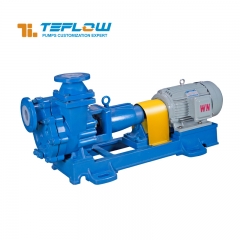
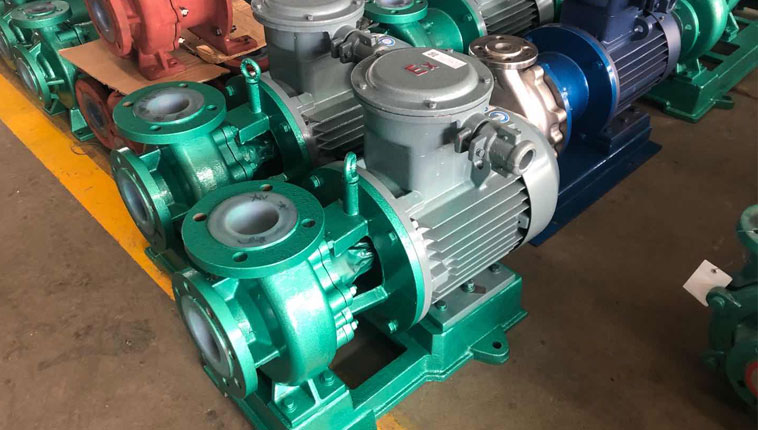
1. Fluoroplastic Centrifugal Pump: Preferred for Strong Corrosion and Medium-Low Working Conditions
Fluoroplastic centrifugal pumps are among the most widely used centrifugal pumps for conveying high-concentration saline wastewater. Their core advantage lies in wetted components made of fluoroplastics (PTFE, PVDF, PFA, FEP, etc.), which are resistant to corrosion from almost all inorganic acids, alkalis, salts and most organic pollutants. They are particularly suitable for conveying highly corrosive wastewater with high Cl⁻ concentration, and also feature light weight, low operating noise and convenient maintenance.
Applicable Scenarios: Medium-low flow rate (1–200 m³/h) and medium-low head (1–100 m) conditions in industries such as coal chemical engineering, printing and dyeing, and pesticide & pharmaceutical intermediates, especially for treating high-salinity wastewater with Cl⁻ concentration >15,000 mg/L and TDS mass fraction of 3.5%–10%. Not suitable for high-temperature (>120 °C), high-pressure conditions or conveyance of wastewater containing a large number of solid particles, as fluoroplastics have low strength and are prone to aging under long-term high temperature and pressure, while solid particles will abrade wetted components.
Selection Key Points: Prioritize reinforced fluoroplastic materials to improve strength and wear resistance; adopt cartridge mechanical seals with self-flushing schemes (e.g., PLAN11) to extend seal life; reserve a 10%–15% margin based on wastewater flow rate and head to prevent pump overload caused by fluctuating working conditions.
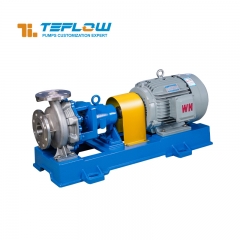
2. Duplex Stainless Steel Centrifugal Pump: Suitable for High-Temperature, High-Pressure, High-Salinity and High-Turbidity Conditions
Duplex stainless steel (2205,2507, etc.) centrifugal pumps combine the corrosion resistance of austenitic stainless steel and the high strength of ferritic stainless steel. Their resistance to Cl⁻-induced pitting corrosion and stress corrosion is far superior to ordinary 316L stainless steel. They are especially suitable for conveying high-concentration saline wastewater under high-temperature, high-pressure conditions with a small amount of solid particles, and also offer good erosion resistance and long service life.
Applicable Scenarios: High-temperature (120–300 °C) and high-pressure (outlet pressure >2.5 MPa) conditions in petroleum refining, evaporative crystallization section of coal chemical engineering, as well as conveyance of high-salinity wastewater with TDS mass fraction >10% and a small amount of suspended particles (particle size <1 mm). Suitable for harsh conditions with Cl⁻ concentration >5,000 mg/L and outlet pressure >2.5 MPa, and can replace 316L stainless steel pumps in more extreme corrosive environments.
Selection Key Points: Select duplex stainless steel of corresponding strength grades according to working pressure (2205 for medium-high pressure,2507for high pressure); adopt closed impellers, and use cast steel or ductile iron for bearing housings to avoid rusting of cast iron in high-salinity environments; the design pressure of the pump casing and the rating of inlet and outlet flanges shall not be lower than PN16.
3. Magnetic Drive Pump: Essential for Zero-Leakage and High-Risk Working Conditions
Magnetic drive pumps adopt a shaftless seal design, driving the impeller to rotate via magnetic coupling to achieve complete sealing of the pump chamber, fundamentally eliminating medium leakage. Meanwhile, wetted components can be made of corrosion-resistant materials such as fluoroplastics and duplex stainless steel, combining corrosion resistance and zero-leakage advantages. They are suitable for conveying volatile, toxic high-concentration saline wastewater to avoid safety accidents and environmental pollution caused by leakage.
Applicable Scenarios: Conveyance of high-concentration saline wastewater containing toxic, flammable and explosive organic pollutants in industries such as pesticide & pharmaceutical intermediates and petroleum refining, as well as closed conveying systems with extremely high leakage control requirements. Suitable for medium-low flow rate and medium-low head conditions, and can be used in highly corrosive environments with high Cl⁻ concentration without concerns about seal leakage.
Selection Key Points: Strictly prohibit dry running, otherwise it will damage the magnetic coupling and isolation sleeve; select wetted component materials according to wastewater corrosiveness (fluoroplastics or Hastelloy for highly corrosive conditions, duplex stainless steel for high-temperature conditions); avoid conveying wastewater containing a large number of solid particles to prevent abrasion of the isolation sleeve and reduced magnetic transmission efficiency; seals require no extra maintenance, with focus on inspecting the operating status of the magnetic coupling.
III. Key Precautions
1.Avoidance of Material Taboos
Ordinary 304 stainless steel is strictly prohibited for conveying wastewater with high Cl⁻ concentration (>5,000 mg/L) to prevent intergranular corrosion. Fluoroplastic centrifugal pumps shall not be used in high-temperature, high-pressure conditions or those containing a large number of hard particles to avoid material aging and abrasion. Wetted materials of magnetic drive pumps must match wastewater corrosiveness to prevent isolation sleeve damage due to improper material selection.
2.Sealing System Maintenance
Mechanical seals are the core sealing components of centrifugal pumps; cartridge mechanical seals shall be selected for conveying high-concentration saline wastewater. Regularly inspect the seal flushing system to ensure clean sealing surfaces and extend seal life. Packing seals are only applicable to low-pressure, non-corrosive and non-toxic conditions, and are strictly prohibited for high-risk high-salinity wastewater conveyance. Magnetic drive pumps require no seal maintenance, but the integrity of the isolation sleeve shall be inspected regularly.
3.Anti-Scaling and Anti-Clogging
Regularly clean the pump body and impeller of centrifugal pumps to remove accumulated crystals and impurities. Adopt smooth flow passage design without dead corners. For easily crystallized wastewater, install filters at the pump inlet to intercept solid particles and crystals, and control conveying temperature to reduce crystallization precipitation. Magnetic drive pumps shall avoid conveying wastewater with a large number of solid particles to prevent abrasion of the isolation sleeve.
4.Later Maintenance
Regularly inspect the abrasion and corrosion of wetted components of magnetic drive pumps and centrifugal pumps, and replace wearing parts in a timely manner. For magnetic drive pumps, regularly check the magnetic strength of the magnetic coupling to avoid reduced conveying efficiency due to magnetic attenuation.



 +86+0563-5093318
