


 +86 18130251359
 teflowpumps@tlpumps.com

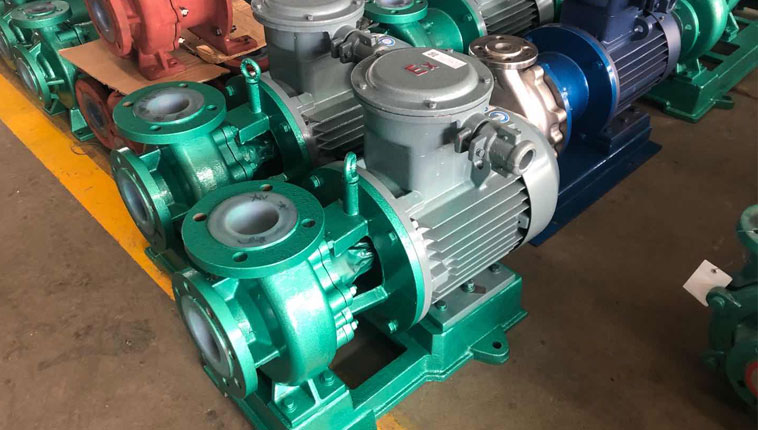
Hydrofluoric acid (HF), an indispensable basic raw material in industries such as chemical engineering, electronics, and electroplating, is highly corrosive, extremely toxic, and volatile. The safety and stability of its transport process have always been the core pain points in chemical production. Unlike common acidic and alkaline media, hydrofluoric acid can corrode almost all materials except specific fluoroplastics and a few special alloys; even a trace leak can cause serious personal injury and environmental pollution. Therefore, selecting a suitable transport pump is the key to ensuring production safety. Among various pump types used in industrial practice, fluoroplastic magnetic pumps have become the universally recognized optimal solution in the industry due to their excellent corrosion resistance and leak-free performance.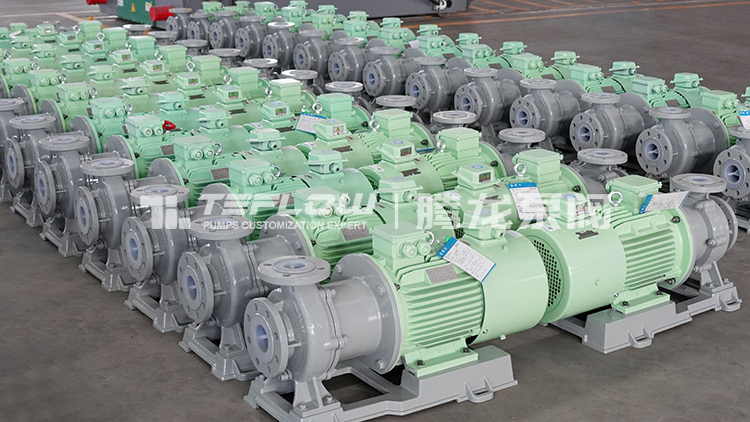
I. The Core Pain Points of Hydrofluoric Acid Transport Determine the Strict Requirements for Pump Selection
To choose an appropriate pump for hydrofluoric acid transport, it is first necessary to clarify the transport challenges posed by the physical and chemical properties of hydrofluoric acid, which is also the key to distinguishing the adaptability of different pump types:
1.Extremely strong and special corrosivity: Hydrofluoric acid is the only acid that can react with silicon dioxide and silicates. Ordinary metal pumps, rubber-lined pumps, and glass pumps cannot withstand its erosion for a long time. Dilute hydrofluoric acid can react with most metals to form fluoride salts and hydrogen; although concentrated hydrofluoric acid with a concentration >70% can passivate iron and aluminum, it still has a strong corrosive effect on most non-metallic materials, placing extremely high requirements on the materials of the wetted parts of the pump.
2.Extreme toxicity and strong permeability: Hydrofluoric acid is highly harmful to the human body. Skin contact can penetrate superficial tissues and erode bones, with insignificant initial pain and a high risk of intractable ulcers in the later stage; inhalation of its vapor can also cause pulmonary edema. Even a trace leak can trigger serious safety accidents, so the sealing performance of the pump must meet the "zero leakage" standard.
3.High requirements for working condition adaptability: In industrial production, the concentration and temperature of hydrofluoric acid vary greatly. In some scenarios, it is necessary to transport hydrofluoric acid containing suspended particles or easily crystallized substances. Meanwhile, its volatility increases with rising temperature, requiring the pump to have good resistance to dry running and crystallization, and to adapt to flow and head requirements under different working conditions.
Traditional mechanical seal pumps, gear pumps, etc., are prone to leakage, component corrosion, frequent failures and other problems in hydrofluoric acid transport due to defects in their sealing structures and insufficient corrosion-resistant materials, failing to meet the requirements for safe production. The unique design and material advantages of magnetic pumps precisely solve the above pain points.
II. Why Fluoroplastic Magnetic Pumps Are the Preferred Choice for Hydrofluoric Acid Transport
A magnetic pump (magnetically driven pump) is a sealed pump that realizes contactless power transmission through the principle of magnetic coupling. Its core design abandons the mechanical shaft seal structure of traditional pumps, and transmits torque contactlessly through an isolation sleeve via the strong magnetic force between the outer magnetic rotor and inner magnetic rotor, fundamentally eliminating medium leakage. Combined with dedicated corrosion-resistant materials, it becomes an ideal choice for hydrofluoric acid transport, with specific advantages reflected in the following four aspects:
1.Zero-leakage sealing: Building a solid safety barrier
This is the core advantage of magnetic pumps and the key to adapting to hydrofluoric acid transport. Traditional mechanical seal pumps rely on contact sealing of sealing components, which are prone to wear and aging after long-term operation, leading to hydrofluoric acid leakage. In contrast, magnetic pumps use static sealing to isolate the pump cavity, completely enclosing the transported medium inside the pump cavity without any dynamic sealing points. This thoroughly eliminates the possibility of hydrofluoric acid leakage through the pump shaft seal, providing fundamental safety guarantees for operators and the production environment, and fully complying with safety standards for high-risk medium transport.
2.Dedicated corrosion-resistant materials: Adapting to the properties of hydrofluoric acid
The wetted parts of magnetic pumps (pump body, impeller, isolation sleeve, etc.) are all made of targeted corrosion-resistant materials. The suitable material can be flexibly selected according to the concentration and temperature of hydrofluoric acid to ensure long-term stable operation:
Fluoroplastic materials (PTFE, PVDF, PFA, FRPP, etc.): Suitable for hydrofluoric acid of all concentrations under atmospheric or low pressure conditions with temperature ≤120℃. They have excellent corrosion resistance, do not react with hydrofluoric acid, and feature high chemical stability, making them the mainstream material choice for magnetic pumps used in hydrofluoric acid transport. The appropriate material is selected based on the concentration of hydrofluoric acid: FRPP magnetic pumps are cost-effective for dilute hydrofluoric acid (concentration <30%); PVDF magnetic pumps offer better mechanical strength than PTFE for medium-concentration hydrofluoric acid (30%–70%); PTFE and PFA magnetic pumps are preferred for concentrated hydrofluoric acid (>70%) or high-temperature working conditions.
Auxiliary materials: The main shaft and shaft sleeve are mostly made of SSIC pressureless sintered silicon carbide, which is self-lubricating and resistant to dry running, avoiding component wear caused by medium crystallization or a small number of particles; the reinforcing sleeve is made of carbon fiber reinforced PEEK, which is free from magnetic eddy current effects and can withstand a pressure of 3MPa, further improving the operational stability of the pump.
3.Stable operation and low maintenance costs
By eliminating vulnerable mechanical seal components, magnetic pumps avoid failures caused by wear and burnout of mechanical seals, significantly improving operational reliability. Meanwhile, the contactless magnetic drive design reduces component friction, lowering maintenance needs and failure rates, and extending the service life far longer than traditional pump types.
4.Strong working condition adaptability: Covering multi-scenario requirements
Magnetic pumps can flexibly adjust their model configurations according to the transport needs of hydrofluoric acid. They can transport both pure hydrofluoric acid and hydrofluoric acid containing suspended particles or easily crystallized substances, meeting hydrofluoric acid transport requirements in various fields such as chemical production, electronics and semiconductors, surface treatment, and environmental hazardous waste treatment.
III. Application Scenarios of Magnetic Pumps in Hydrofluoric Acid Transport
1.Chemical production: Transport of hydrofluoric acid raw materials, feeding of reaction kettles, product circulation, and medium transfer in the manufacturing process of fluorides, adapting to hydrofluoric acid transport needs of different concentrations and temperatures.
2.Electronics and semiconductors: Precise supply and circulation of hydrofluoric acid solution in wafer etching and cleaning processes, requiring pumps with zero-leakage and high-precision transport capabilities to avoid wafer contamination.
3.Surface treatment/electroplating: Addition and circulation of pickling and etching tank solutions, adapting to medium and low-concentration hydrofluoric acid, and effectively preventing tank liquid leakage to ensure operational safety.
4.Environmental protection and hazardous waste treatment: Collection and safe transfer of hydrofluoric acid-containing waste liquids, where corrosion-resistant and zero-leakage magnetic pumps must be selected to avoid environmental pollution from waste liquid leakage.
The strong corrosivity, extreme toxicity, and volatility of hydrofluoric acid determine that its transport pump must possess the core characteristics of "zero leakage, strong corrosion resistance, and high stability". With its contactless magnetic drive design, magnetic pumps fundamentally eliminate medium leakage. Combined with targeted corrosion-resistant materials and flexible working condition adaptability, they perfectly solve the potential safety hazards and operational problems in hydrofluoric acid transport. Compared with traditional pump types, they not only improve production safety but also reduce maintenance costs and shutdown losses. In actual type selection and application, it is necessary to strictly combine working condition parameters such as concentration, temperature, and flow rate of hydrofluoric acid to accurately select suitable materials and models, and standardize daily operation and maintenance. Only in this way can the advantages of magnetic pumps be fully brought into play to ensure safe, stable and efficient hydrofluoric acid transport and provide strong support for chemical production.



 +86+0563-5093318
